


Montipora-Eating Nudibranchs
Phestilla subodiosa
Identification, breeding cycle, treatment and prevention
Written by Christian, Signature FragsLast reviewed:
What Are They?
Montipora-eating nudibranchs are tiny coral-eating sea slugs that feed directly on living Montipora tissue.
They’re strongly associated with Montipora and are one of the better-known SPS pests in reef aquariums.
They’re small, pale, well camouflaged and very easy to miss, especially because they tend to sit around:
- The underside of plating Montipora.
- Shaded areas.
- Branch junctions.
- Dead skeletal margins.
- The edge of active tissue loss.
Identification

Think of them as tiny, pale, frilly sea slugs.
They are usually:
- White.
- Cream.
- Pale grey.
- Semi-translucent.
Their backs are covered in lots of small finger-like projections called cerata, which give them a fuzzy or frilly appearance.
Because they’re often very close in colour to exposed Montipora skeleton, they can almost disappear against the coral.
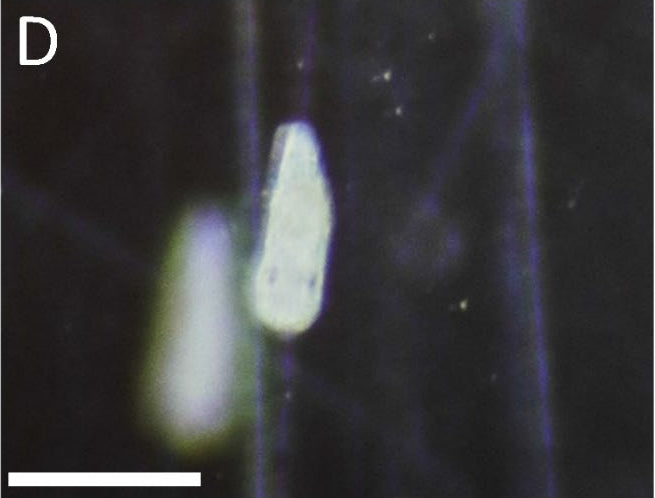
Juveniles — the next generation
A post-metamorphosis juvenile, shown under magnification. The original scale bar is 300 µm. Inspect for these tiny mobile stages as well as adults and egg masses.
What Does the Damage Look Like?
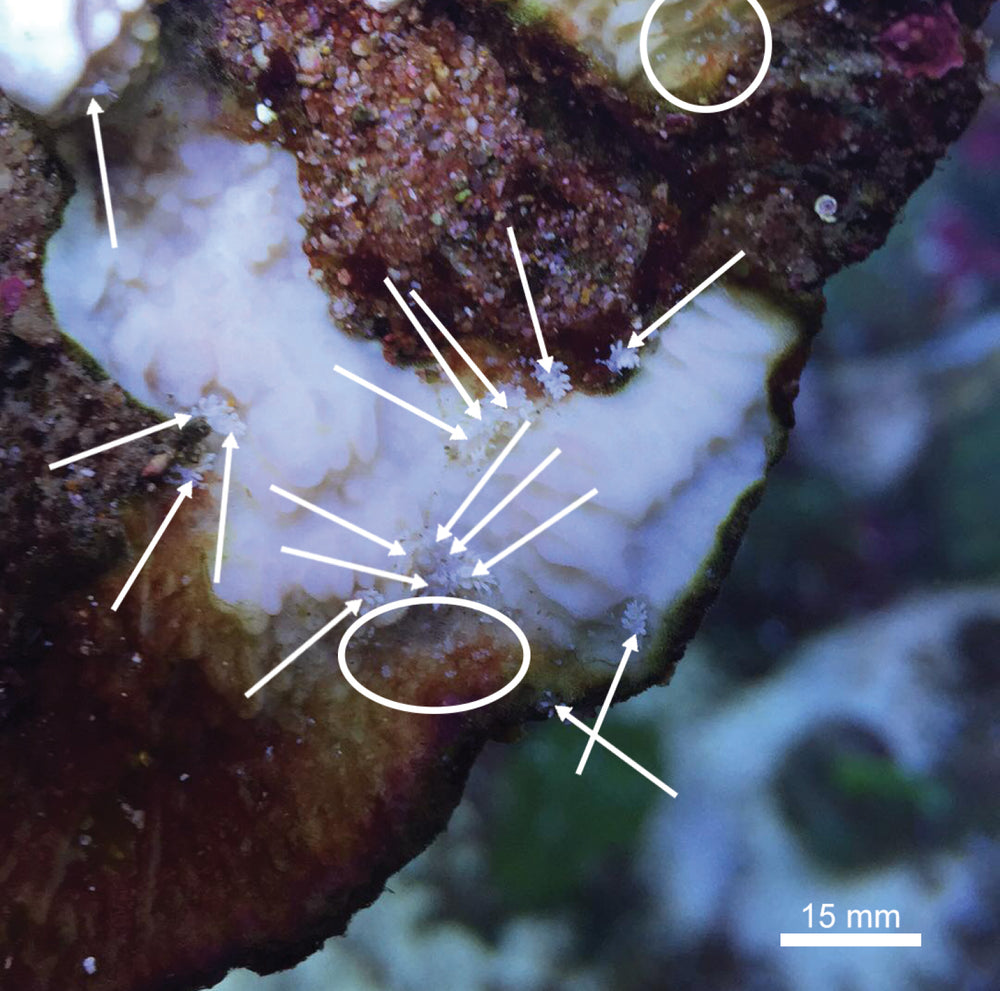
The most obvious sign is usually fresh white skeleton where living Montipora tissue has been eaten away.
Look for:
- White patches appearing for no obvious reason.
- Tissue being eaten back from an edge.
- Damage spreading along a plate.
- Tissue loss starting underneath a colony.
- Fresh skeleton around the base.
- Small nudibranchs sitting right along the feeding edge.
The line between healthy tissue and stripped skeleton can sometimes be very obvious.
Discovery and Identification
The first sign is usually fresh white skeleton or unexplained tissue loss.
If you suspect Montipora-eating nudibranchs, inspect the coral underwater.
Hold it upside down and look closely around the growth margins, underside, base and any freshly exposed skeleton.
Underwater, the nudibranchs keep that pale, frilly appearance, which makes them much easier to recognise.
Out of water, they flatten down and can look like nothing more than a bit of slime stuck to the coral.
And if you find one, don’t assume that’s the only one.
Treat it as confirmation that the problem is established and immediately start looking for more nudibranchs and egg masses.
Eggs

The eggs are one of the reasons these can be difficult to clear.
They are usually laid in small pale or white clusters, often tucked into protected areas on or close to the affected coral.
They may appear as:
- Small white egg masses.
- Tight little coils.
- Spirals.
- Pale clustered patches on bare skeleton.
Look carefully around:
- Dead tissue margins.
- The underside of plates.
- Frag plugs.
- Branch bases.
- Shaded skeleton.
Understanding the Breeding Cycle
At around 24°C, larvae can become capable of settling at roughly day 6; once they encounter living Montipora cues, they settle and metamorphose.
Treatment must therefore be treated as a cycle: repeatedly remove mobile stages and physically remove egg masses until no animals remain to reproduce.
With Monti nudibranchs, the real battle is breaking that breeding cycle, not just knocking off the adults you see. The eggs develop fast. At around 24 degrees, larvae can be ready to settle within about a week once they’ve got the right host, which means if you stop after one round, you’re basically just waiting for the next generation. I’d frame treatment as a cycle. Remove adults, remove eggs, inspect again, and keep going until you’re certain the cycle is broken, not just until you can’t see adults anymore.
Immediate Containment
Once you’ve spotted one, I’d go straight into containment mode.
First, take that Montipora out of the display if you can and inspect it underwater from every angle. Remove every nudibranch you can see, then start looking for egg masses around the growth margins, underside, base, plug and any dead skeleton.
Then check every other Montipora in the system. Don’t assume it’s just on the one colony.
After that, I’d move the affected Montis into quarantine if possible. You can use a coral dip to help knock off mobile nudibranchs, but don’t trust the dip to deal with the eggs. The eggs need to be physically found and removed.
And then comes the important bit: repeat the inspection and treatment cycle. You’re trying to catch each new generation before it gets established and starts laying more eggs.
Treatment
For an active Montipora-eating nudibranch problem, I’d keep the treatment simple and consistent. Use a proper coral dip such as Coral Rx, or an iodine-based dip, to target the mobile nudibranchs. While the coral is in the dip, use a turkey baster or gentle jet of water to really work around the underside, base, branch junctions and any folds or crevices where they can hide. The important bit is the eggs. Don’t assume the dip has dealt with them. Inspect the coral closely and physically remove any egg masses you find.
During an active outbreak, repeat the process every 3-4 days. The aim is to catch newly hatched juveniles before they have time to mature and start laying more eggs. Keep going until you’ve had several completely clean inspections with no adults, no juveniles, no eggs and no fresh feeding damage.
I’d leave potassium permanganate in the guide as a historical, high-risk option rather than something we recommend as standard, because although it has been reported to affect eggs as well as adults, it can also be very hard on Montipora tissue.
Potassium Permanganate - Historical High-Risk Option
Potassium permanganate is one of the more aggressive treatments that has been used for Montipora-eating nudibranchs.
A well-known protocol associated with Eric Borneman used around 50 mg/L for approximately 90 minutes, with the aim of killing both the nudibranchs and their eggs.
It can work.
But it is extremely harsh on Montipora, and there is a very real risk of badly damaging or even killing the coral you are trying to save.
So although potassium permanganate is a recognised treatment option, it is not the approach we would recommend as the first line of treatment.
Our preference would be to use a normal coral dip to deal with the mobile nudibranchs, physically remove any eggs you can find, and then repeat that process often enough to interrupt the breeding cycle.
In other words, rather than trying to destroy everything in one extremely aggressive treatment, the aim is to:
- Remove the adults.
- Remove the eggs you can see.
- Catch each new generation as it emerges.
- Keep going until the lifecycle is broken.
Follow-Up
Don’t stop treatment just because you can’t see any nudibranchs after the first dip. The mobile adults and juveniles are usually the easy part - the eggs are what keep the infestation going. Commercial dips and iodine-based treatments generally don’t reliably affect the eggs, so repeated treatment and manual egg removal are essential.
During an active outbreak, inspect and treat the affected Montipora every 3-4 days. At each check, look closely around the underside, base, dead skeleton, shaded areas and tissue margins. Remove any egg masses you find and flush or dip the coral to remove mobile nudibranchs.
Keep that rhythm going until you’ve had several completely clean inspections in a row - no adults, no juveniles, no eggs and no fresh feeding damage.
Even once everything looks clean, keep inspecting for a while afterwards rather than immediately assuming the problem has gone. At Signature Frags, we’d rather over-check than stop too early. One missed egg mass can restart the whole cycle.
Quarantine
Anything new or even slightly suspicious should be kept away from established Montipora until you are satisfied it is clean.
Inspect the coral from every angle, not just the visible upper surface. Look closely for feeding damage, adult or juvenile nudibranchs and the characteristic egg masses. Any eggs found should be physically removed rather than relying on a dip to deal with them.
If there is any doubt, keep the coral isolated. Don’t move a questionable Montipora between systems just because it looks clean after one inspection or one dip.
Montipora-eating nudibranchs are one of those pests where being overly cautious at the quarantine stage is considerably easier than trying to remove them from a mature system later.
If every Montipora host is removed from an affected system, host removal may also help break the cycle because these nudibranchs are strongly host-associated. That does not replace repeated inspection of removed coral and wet equipment.
Coral Recovery
Once the feeding has stopped, give the coral a chance to recover.
Pay attention to:
- Alkalinity.
- Calcium.
- Magnesium.
- Salinity.
- Temperature.
- Flow.
- Lighting.
Don’t keep handling or dipping the coral unnecessarily once you’re confident the pest has gone.
Prevention
With Montipora-eating nudibranchs, prevention is far easier than trying to eradicate them once they’re established.
For us, that starts with sourcing. We don’t bring in fresh-import Montipora. The adults can be extremely difficult to spot and the eggs are even easier to miss, so for us the risk simply isn’t worth taking. Our Montipora are sourced with aquaculture in mind rather than repeatedly introducing fresh wild or imported colonies into established systems.
Any new Montipora should still be inspected carefully, paying particular attention to the underside, base, areas of exposed skeleton and any folds or crevices where adults or eggs could be hidden.
Signature Frags Perspective
When we get fresh Montipora in, we’re extremely careful. I use what I call “coring” the Montipora: I cut a perfect circle out of the centre/top of the colony, then cut all the flesh from underneath away, leaving a circular piece of living tissue with the edge and underneath bare skeleton. I discard the base and underside because Montipora-eating nudibranchs are usually found underneath, around the edges and growth margins, and work their way inwards from below. That way, the only thing going into the system is living flesh.
Christian’s Take
Montipora-eating nudibranchs are brutal. If they get in, you may lose the whole Monti lineup, so do not underestimate them. Prevention first, because recovery is not guaranteed.
This pest is no joke. It’s one of the hardest reef pests to deal with. If you get it, be prepared for the fact that you might have to strip your Montipora collection right back and start again. That’s not scaremongering, that’s honesty. And it’s why, with Montipora, prevention and over-caution are always the better bet.
These are one of those pests where the biggest mistake is only looking at the bit of coral you can see. Turn the Monti over. Look underneath it. Look at the base. Look around any fresh white skeleton. If you find a nudibranch, assume there are more. And if you find adults, assume there may be eggs. Don’t overcomplicate the treatment. Remove what you can see, remove the eggs, dip if it helps, and keep checking. The key is not the first treatment. The key is making sure the next generation never gets the chance to take over again.
References
Wang, A., Conti-Jerpe, I.E., Richards, J.L. & Baker, D.M. (2020). Phestilla subodiosus sp. nov. (Nudibranchia, Trinchesiidae), a corallivorous pest species in the aquarium trade. ZooKeys 909, 1-24. DOI: 10.3897/zookeys.909.35278. PMCID: PMC7015969.
Yiu, S.K.F. & Qiu, J.W. (2022). Morphology, Feeding Rate and Larval Settlement Preference of the Corallivorous Nudibranch Phestilla subodiosa (Nudibranchia: Trinchesiidae) from Hong Kong. Zoological Studies 61:59. DOI: 10.6620/ZS.2022.61-59. Larvae required approximately six days to become competent for settlement; maximum recorded metamorphic rate occurred later in the settlement experiment.
Borneman-associated potassium permanganate treatment: historical reef-aquarium literature, approximately 50 mg/L for around 90 minutes to 2 hours. Retained here only as historical/high-risk context; not recommended as routine Signature Frags treatment.
Image Credits
Background supplied by Signature Frags.
Adult and egg photographs: Wang A., Conti-Jerpe I.E., Richards J.L. & Baker D.M. (2020), ZooKeys 909, Figure 2. Original photograph; CC BY 4.0. Cropped into separate adult and egg panels, with scale bars retained.
_Figure_2.jpg)
Host coral, settled nudibranchs and egg clusters: the same authors, Figure 1. Original photograph; CC BY 4.0. Full image in the damage section; cropped for the hero and pest-library card.
_Figure_1.jpg)
Juvenile photograph: Sam King Fung Yiu & Jian-Wen Qiu (2022), Zoological Studies 61:59, Figure 5D. © Academia Sinica, Taiwan. Study and original figure. Cropped to the juvenile panel with its 300 µm scale. Image reuse permission has not yet been confirmed; retained in this unpublished draft for review.
More from the Coral Pest Library
SPS Beyond Acropora Care Guide →
Drupella coral-eating snails guide →
Acropora-eating flatworm guide →
Explore Pests & Problems