

Coral-Eating Snails
Drupella spp.
Identification, eggs, removal and follow-up
Written by Christian, Signature FragsLast reviewed:
What Are They?
Basically, these are little coral-eating snails that feed directly on living coral tissue. They’re not an Acropora-only pest, but Acros and other branching SPS are very much on the menu. They also turn up on Monti, Pocillopora, Stylophora, and will switch if they have to.
Identification
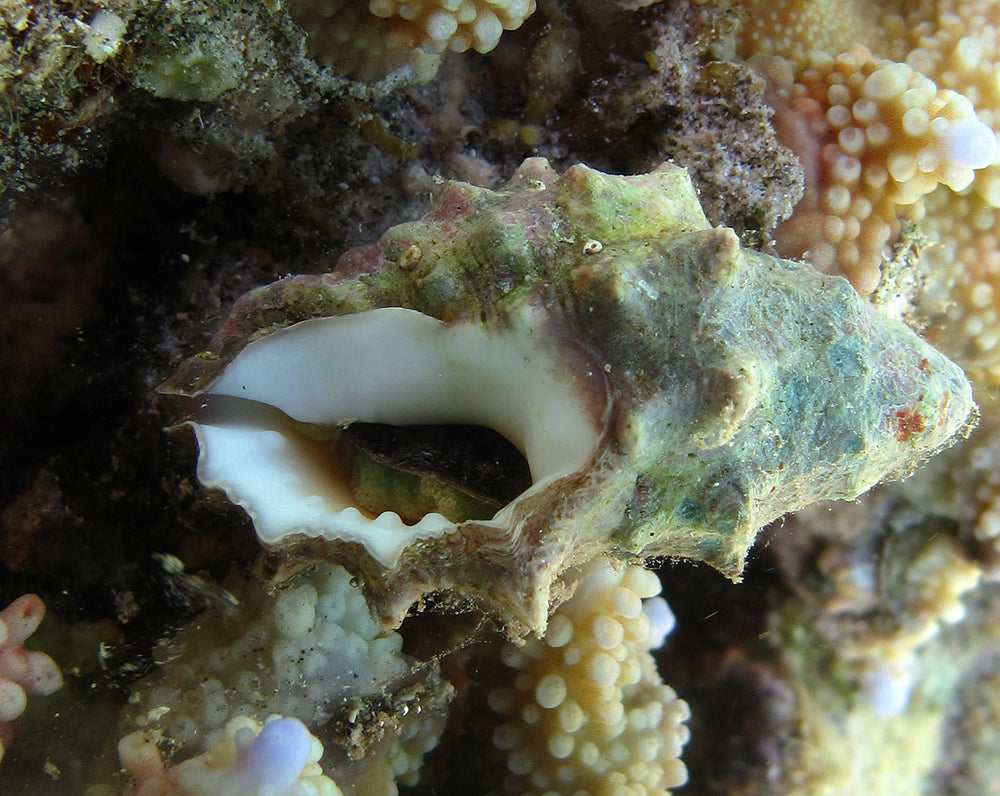
Look for a small, rough, whelk-like shell, sometimes covered in coralline so they blend in really well. Small ones around 5 to 10 mil, bigger adults up towards 30 mil, give or take.
More formally, small individuals may be around 5-10 mm, while larger adults can reach roughly 30-35 mm; many mature animals are around 20-30 mm long. Their rough shell and coralline growth can make them surprisingly easy to dismiss as harmless clean-up crew.
Damage

The damage is often the giveaway. Fresh, bright white skeleton with a pretty sharp edge against healthy tissue.
Confirming It
To confirm. Use white light, check deep in the branches, plugs, bases, fresh skeleton. A torch, after dark, is worth doing.
- Look between branches and around the base.
- Check immediately beside fresh white feeding scars.
- Use a night torch because snails can be easier to find after dark.
- Do not assume a whelk-like snail sitting on freshly stripped coral is harmless clean-up crew.
Eggs
Eggs are small cream blister-like capsules on bare skeleton usually clustered in sheltered spots, and that location is the clue.
They can look a bit like dove snail eggs, but dove snails lay those clear little domes on glass or rock, not tightly clustered on stripped coral skeleton.
Drupella egg capsules are generally small, pale cream to yellowish, blister-like or flattened oval capsules, attached firmly to bare/dead coral skeleton. They are often laid in clusters in sheltered areas. Fresh capsules are typically cream coloured and can darken toward brown as embryos develop.
Treatment
Treatment. Keep it simple. Manually remove every snail that you can find. Go slowly, check every branch junction, remove any egg capsules you see. Don’t rely on dips to solve it. Dips might help you spot things, but they’re not the fix.
- Physically remove every visible snail with forceps or another suitable tool.
- Inspect branch junctions, bases, plugs, fresh skeleton and sheltered areas.
- Physically remove egg capsules.
- Use a dip only as a supporting inspection/dislodgement tool, not as the core eradication method.
Biological Pressure
Certain wrasses have been reported consuming juvenile Drupella, with predation specifically noted from some Thalassoma and Coris species. That does not mean adding a wrasse should be considered a reliable treatment. Treat this as supplementary biological pressure only, not a replacement for physical removal and repeated inspection.
Follow-Up
Follow-up is regular checks over the next few weeks. Just keep checking until you stop finding them.
Because egg capsules can remain after adults are removed, repeated inspection matters. One clean check does not prove the problem has finished.
Coral Recovery
Once the feeding stops, focus on stability, let the coral recover, don’t keep messing with it unless you really need to.
- Keep alkalinity, calcium and magnesium stable.
- Avoid unnecessary handling once feeding has stopped.
- Watch for new white feeding scars as the clearest sign that something remains.
Prevention and Quarantine
Prevention’s careful inspection in QT, not dipping alone.
- Inspect new coral and its base closely under white light.
- Check again after dark.
- Look for both the snail and the egg capsules on bare or recently stripped skeleton.
- Do not move a questionable coral between systems just because one dip or one quick inspection looked clean.
Signature Frags Perspective
And for the Signature Frags line, call it what it is: a general coral pest, not Acropora specific, but with a strong Acropora preference.
Christian’s Take
If a little whelk-like snail is sitting on fresh, white skeleton, don’t assume it’s clean-up crew. Investigate. Don’t overthink it, just pull it, check around, remove any you find.
References and Evidence Notes
Sam, S.Q., Toh, T.C., Kikuzawa, Y.P., Ng, C.S.L., Taira, D., Afiq-Rosli, L., Tan, K.S. & Chou, L.M. (2017). Egg capsules and veligers of the corallivorous muricid gastropod Drupella rugosa (Born, 1778). Invertebrate Reproduction & Development 61(3), 164-171. DOI: 10.1080/07924259.2017.1315343. The study recorded egg capsules on bare coral skeleton and 15 days of intracapsular development before veliger release.
Reports of wrasse predation on juvenile Drupella are retained as supplementary biological-control context only. The Signature Frags treatment remains physical removal, egg removal and repeated inspection rather than relying on a fish predator.
Image Credits
Reef Acropora: Petra Lundgren, Juan C Vera, Lesa Peplow, Stephanie Manel and Madeleine JH van Oppen. Original photograph and source. CC BY 4.0. Cropped for the hero.

Background supplied by Signature Frags.
Drupella cornus identification photograph: Philippe Bourjon, Réunion, 1 September 2013. Original photograph. CC BY-SA 4.0. Full image resized for display.

Drupella rugosa feeding aggregation photograph: ConserveMarine, Koh Tao, Thailand, 30 August 2010. Original photograph. CC BY-SA 4.0. Full image resized for display; the pest-library thumbnail uses a crop under the same licence.

More from the Coral Pest Library
Classic Acropora-eating flatworm guide →
New Acropora-eating flatworm guide →
Acropora parasitic copepods guide →
Explore Pests & Problems