


CORAL CARE GUIDE
Grow Acropora with confidence
Acropora are small-polyp stony corals and, for many reef keepers, one of the most rewarding groups of coral to grow.
Their colour, structure and growth forms can completely transform a reef, but they require patience and consistency.
Acropora are best suited to patient reefers who have the ability to maintain stability and consistency. If your aquarium is still experiencing regular parameter swings, there is nothing wrong with waiting until the system has matured and settled before adding them.
Difficulty Advanced
Written by Christian, Signature FragsLast reviewed:
AT A GLANCE
Quick-Glance Parameters
This guide provides our general care recommendations for Acropora. Check the Care section on each product page for advice specific to that coral, including lighting, flow and placement. Where we recommend an adjustment to this guide, we’ll explain it clearly there.
These figures are guides rather than numbers to chase every day.
Choose appropriate values within the ranges and concentrate on keeping your aquarium consistent.
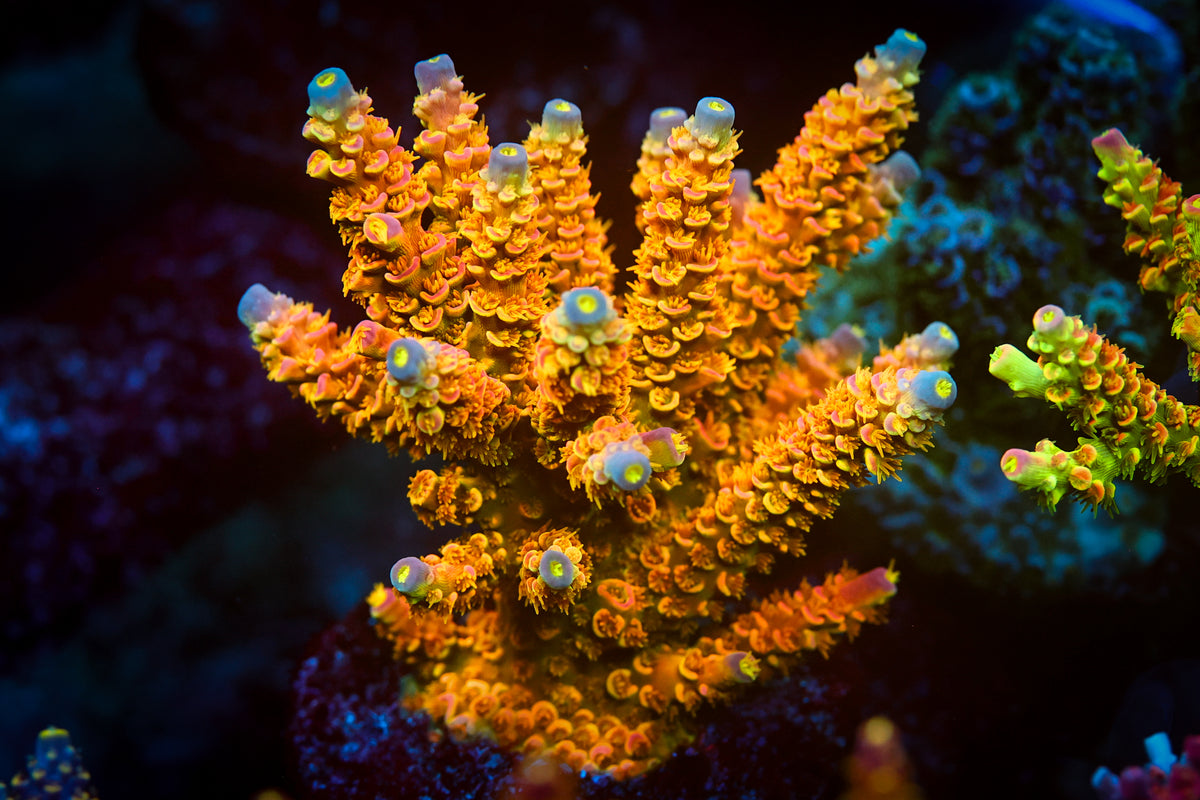
01 · ENVIRONMENT
Lighting
Aim for approximately 200–450 PAR once the coral is fully acclimated.
Acropora generally perform best where light reaches the colony from multiple angles rather than from one harsh point directly above it.
We favour diffused lighting coverage, either from multiple individual light sources or larger diffused panels, allowing light to wrap around the colony.
A newly introduced frag should not be placed immediately into your highest-light position.
Follow our Receiving Your Coral — Acclimation & First 24 Hours guidance first, then increase exposure gradually as the coral settles.
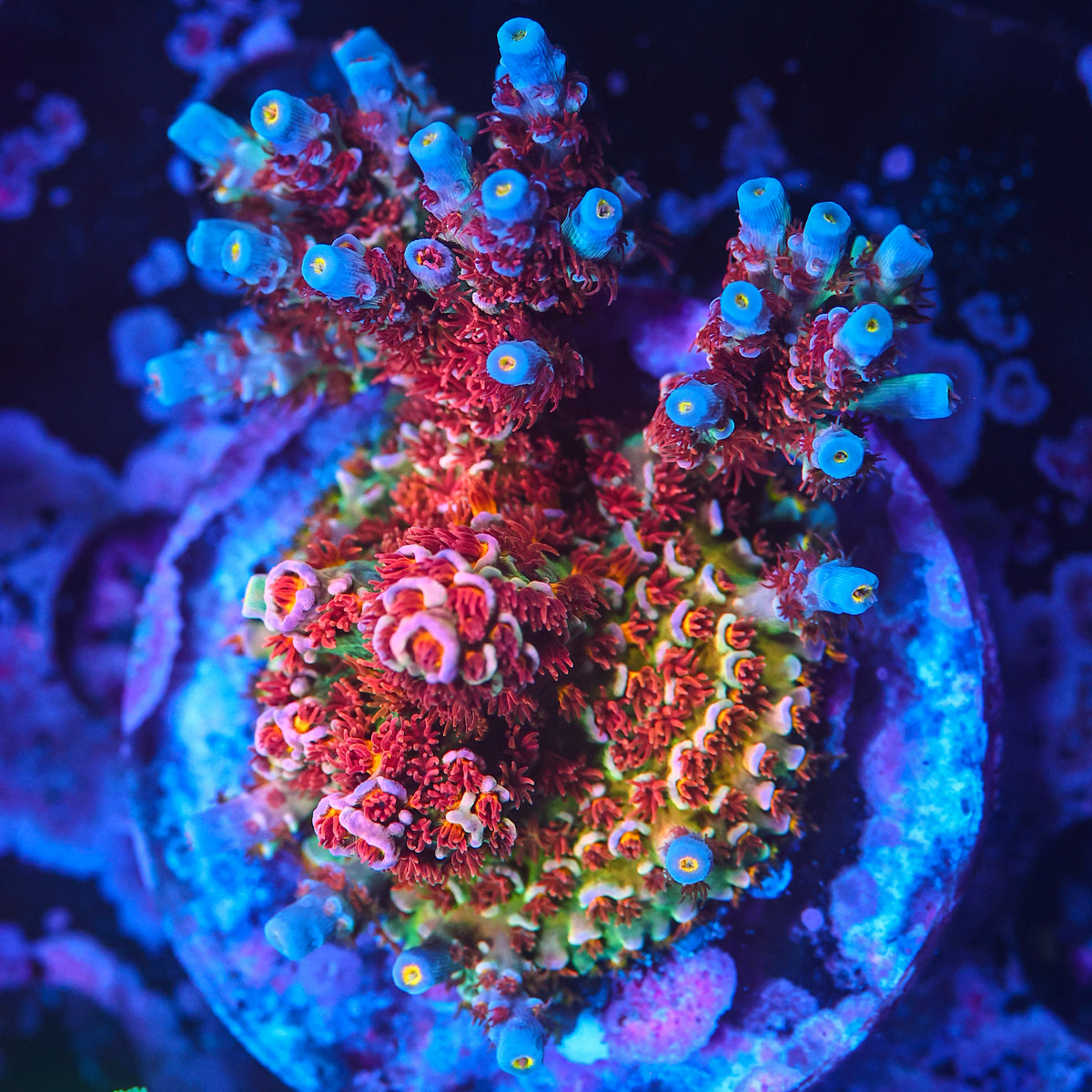
02 · MOVEMENT
Flow
Acropora require strong, indirect and varied water movement.
Think chaotic and changing rather than a constant jet aimed directly at the coral.
The goal is for water to move around the whole colony, keeping the tissue well oxygenated and preventing stagnant areas.
Good flow also helps prevent detritus from settling between branches as the colony develops.
Strong flow is beneficial.
Directly blasting the tissue is not.

03 · POSITION
Placement
Start conservatively.
Allow the frag to complete its initial acclimation before gradually moving it towards its intended position.
Make small changes, then watch the coral.
Positive response? Continue gradually.
Negative response? Go back a stage and give it more time.
Don't rush to glue a new Acropora high on the rockwork simply because it is ultimately a high-light coral.
Patience at the beginning often produces faster progress later.
Allow enough room for the colony's eventual growth form. Established Acropora can compete with neighbouring corals for space, flow and light.
04 · THE PRIORITY
Stability
For Acropora, stability matters more than perfection.
Constantly chasing numbers can create more problems than maintaining slightly different but consistent values.
If something needs adjusting, make changes slowly.
Watch the coral itself. Useful signs include healthy polyp extension, good tissue and colour, and continued new tip growth.
Numbers matter.
So does the coral's response.

05 · NUTRITION
Feeding & Nutrition
Acropora obtain much of their energy from light, but they still benefit from a healthy, well-fed reef system.
We favour consistent low-level nutrition rather than heavy target feeding.
Suitable options can include fine particulate coral foods, zooplankton and amino acids, provided they suit the nutrient balance of your aquarium.
Avoid heavy feeding simply for the sake of feeding. More is not automatically better.
Whatever approach you take, avoid sudden major changes to feeding or nutrients.

06 · STRUCTURE
Acropora Growth Forms
Acropora develop in a wide range of forms. Growth habit affects how much room a colony needs and how light and water move around it.
- Branching — develops defined branches that can form large, complex colonies.
- Tabling — grows outwards into broad horizontal plates and requires excellent water movement as it expands.
- Staghorn — produces longer, relatively open branches and can grow quickly in favourable conditions.
- Bushy or compact — develops densely packed branches, making strong, varied flow especially important.
Individual species and specimens can behave differently, so use the expected growth form as a guide and continue to watch the coral's response.
READING THE CORAL
Signs of a Healthy Acropora
A healthy, settled Acropora may show:
- consistent colour appropriate to its environment;
- intact tissue covering the skeleton;
- new growth at branch tips or edges;
- encrusting growth around the base; and
- stable polyp extension that is normal for that particular variety.
Polyp extension varies considerably between Acropora. Some healthy varieties naturally show less extension than others, so it should never be used as the only measure of health.
PAUSE AND INSPECT
Warning Signs
Look more closely if you notice:
- a sudden loss of colour, darkening, paling or bleaching;
- tissue recession, including STN or RTN;
- unexplained areas of exposed white skeleton or algae growing over dead skeleton;
- a sustained reduction in polyp extension or loss of lustre;
- a lack of new growth alongside other signs of stress; or
- bite marks, egg clusters or other physical evidence of pests.
One sign on its own does not always reveal the cause. Check what has changed, confirm stability and inspect the coral carefully before making several adjustments or beginning aggressive treatment.
KEEP IT SIMPLE
Common Mistakes
The most common problems aren't always caused by one bad parameter. They're often caused by doing too much, too quickly.
Avoid:
- repeatedly moving the frag;
- constantly changing dosing to chase numbers;
- blasting tissue with direct flow; and
- immediately exposing newly introduced coral to maximum lighting; and
- overfeeding or changing nutrient levels too quickly.
With Acropora, impatience is often the biggest mistake.
Christian’s Take
Christian’s Take
At Signature Frags, our Acropora are conditioned across multiple systems with different parameter ranges, dosing methodologies and environments.
That conditioning is designed to encourage adaptability.
What we do at the farm isn't an instruction to deliberately create instability in your own reef.
At home, my advice is much simpler:
Be patient. Keep your parameters steady. Make changes gradually — and let the coral show you what it wants.
COMMON QUESTIONS
Acropora FAQs
How quickly will my Acropora grow?
Growth rates vary considerably between aquariums and species.
In a suitable, stable system, early signs that a frag has settled include new tip growth and healthy, consistent polyp extension.
Once established, growth will often strengthen over time.
Why has my Acropora changed or lost colour?
Colour shifts are usually a response to environmental change.
Lighting, nutrients, alkalinity, trace elements, flow, stress and pests can all play a role.
Think about what has changed recently, inspect the coral carefully and avoid reacting by changing several things at once.
Make corrections gradually and watch the response.
Where should I place a new Acropora frag?
Follow our Receiving Your Coral — Acclimation & First 24 Hours process first.
Once settled, make small placement changes over time.
Positive response? Continue gradually.
Negative response? Step back and give it more time.
The goal isn't to get the coral into its final position quickly.
It's to get it there successfully.
What pests can affect Acropora?
Potential pests include Acropora-eating flatworms (AEFW), parasitic copepods commonly referred to as red, black or white bugs, sea spiders and occasionally predatory coral crabs.
If something looks wrong, don't panic or act immediately.
Check stability, inspect the coral carefully and look for physical evidence before making major changes or carrying out aggressive treatments.
If you're unsure, get a second opinion.
Acropora-eating flatworms: identification and treatment →New Acropora-eating flatworm: identification and treatment
NEXT STEP
Ready to explore Acropora?
Browse our established, aquacultured Acropora grown and conditioned here at Signature Frags.